High Tide 3.93m @ 09:10, Sunrise 07:13, Team meet time 06:30, Catch 08:31
After an aborted session at Dawlish Warren in January due to high water levels in the estuary changing the birds roosting behaviour, reconnaisance earlier in the week looked promising for a catch. A final recce on the Friday morning tide by Nik and Robin assessed that setting a half-net, firing down finger point would be practical would stand a good chance of catching Oystercatcher, our target species.
After a briefing in darkness in the car park, the team, most of whom had some experience of cannon netting, made their way to the point and waited quietly for the rising tide to push birds into the catching area. Regular feedback from Robin kept optimism high and after only about 45 mins the net was fired, with the tide still to reach its peak. The lift went well although hampered slightly by quite a bit of drift debris. Extraction was by necessity quick and efficient with the water level still rising, and all birds were soon moved to safety in keeping cages. The catch totalled 2 Curlew and 95 Oystercatcher.
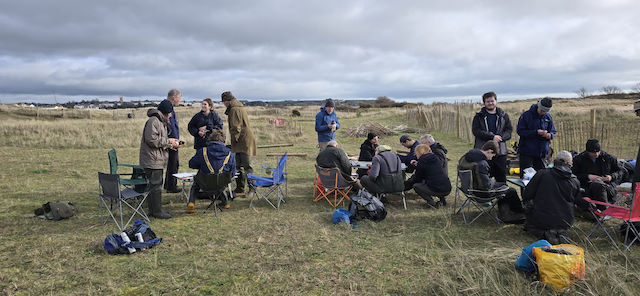 The processing teams in action
To reduce stress on a senstive species, the Curlew were processed first and released promptly with colour rings. Three teams were then established to process the Oystercatchers; Nik leading the metal riniging, Chris running the biometrics team and Tim supervising the colour ringing. The team soon settled into an efficient routine with numbers of people assigned to each task balanced to minimise delays. Ten of the Oystercatchers were already carrying colour rings from 2018, 2019 and 2021. Due to wear making some colour rings illegible, all were replaced with new codes. Two retraps also had colour rings added. Plenty of opportunity was provided to the less experienced ringers to build their confidence in fitting larger rings and in taking wader biometrics. Non-ringers also played an important role in record keeping, ensuring the operation ran smoothly. All birds were processed and released by 12 noon.
The net was cleared of debris and all equipment packed up in time for the wardens to collect and return it to the compound, after the traditional team photo (below). Pasties and coffee for lunch were enjoyed at a local cafe before the team dispersed happy that we had boosted the colour-marked population of Oystercatchers on the Exe Estuary. It is hoped that these birds will continue to be re-sighted for many years to come.
Thanks to everyone who turned out to help, but especially to the Teignbridge Council team for allowing us to access the site and for their help with transporting the kit. Thanks also go to Devon Wildlife Trust and the Warren Golf Club for allowing our continued access to the site via their land.
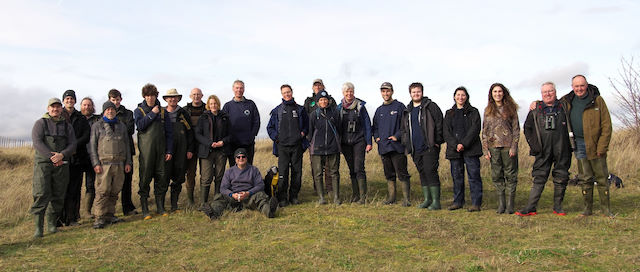 Team photo, illustrating how many peiple it takes to run a successful cannon net catch
A follow-up visit to the site on the following day by our regular and diligent colour-ring readers, Lee and Kev, amassed over 100 re-sightings of DCWRG birds. Mostly Oystercatchers and Dunlin, but also 5 Grey Plover and a Curlew.