HT 3.76m @ 19:46, Sunset 17:02, Meet Time – 16:00
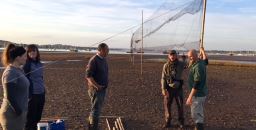
As the dimming afternoon light washed over Exminster Marshes, the 13-strong team assembled at the RSPB carpark, donned their boots and waders and made their way along the flooded road towards the catching fields.
 Mist-nets on the Exminster Marshes lagoons © Nik Ward
The group split into two teams to put up the mist-nets. The larger team set-up two lines of nets (10 nets in total) in the lagoon fields near the ringing station. In a further field, Ryan, Ezra and Flo used 2-shelf nets to create a Y-shape formation of 4 nets and a separate line of 2. Interestingly, despite the lower number of nets, these two sets were more productive than those in the main lagoons. Tape lures were set to play Curlew and Lapwing calls on the nets set in the further field, with the aim to call in these species as the tide pushed them up to roost. The fields were muddy to say the least, and there were some near misses of slipping over in the squelch!
Setting began at 16:45 and was completed before complete darkness around 17:30. Once dark, the tape lures were switched on. The evening began starry and clear, but cloud cover gradually increased as the night progressed. Thankfully the moon was just a silver sliver and so did not cause too much illumination.
An initial net round brought back 2 Snipe. Then throughout the rest of the session there was a slow stream of a range of species, although low in numbers. Despite the use of species-specific tape-lures in the further field, and the apparent high presence of Lapwing (hearing them calling everywhere all through the night!) only one was caught during the session. With its glossy sheen and unique crest, this wader was probably the highlight of the evening for much of the team.
The tide did not rise as high as expected, reaching approximately 15cm less than predicted. This will most likely have made a difference to the catching numbers as, for example, the Curlew remained out on the mudflats of the Exe Estuary. The slow pace did give the chance for lots of training and processing practice. Furthermore, although only low numbers of waders were caught, overall, there was a good variety with 15 birds of 8 species caught. This was great for the newer members of the team to gain experience with ringing and aging the different species.
 Colour-ringing a Curlew © AJ Bellamy
 Colour-ringed Grey Plover © AJ BellamyDunlin, Curlew and Grey Plover were all colour-ringed and just one day later we already had news of the Curlew and Grey Plover being resighted nearby!
The team shared a packet of Jaffa Cakes halfway through the session, fuelling them on in the increasingly chilly evening.
 Black-tailed Godwits © AJ BellamyAround 22:00, a small group went to take down the nets in the further field. This produced a last-minute surprise of two Black-tailed Godwit which were returned to the ringing station to be processed. The nets in the lagoon field were taken down. Before we trudged, a little tired but more importantly cheerful and covered in a respectable volume of mud, back along the road to the car park Nik thanked the team for the evening. He noted the super effort put in by all in both training and learning, particularly Sam who did an excellent job of keeping on top of the scribing throughout the night.
The team are very grateful to Ryan and Nik who led the session and who put so much effort into the organisation of these catches.
Finally, a well-needed thanks to the RSPB and David King for continuing to allow the group to access and operate on their land. The group would not be able to collect vital data on the waders using these habitats without these permissions.
Report by Florence Turner