High Tide 3.50m @ 21:22, Sunset 19:44, Rendezvous 18:30
The Covid-19 pandemic has had and continues to have a significant impact on all our lives. It has affected our health and limited our ability to see friends and family, travel and conduct work as normal. Throughout the pandemic, there has been a constant review of ringing activities by the BTO. The DCWRG committee has kept the guidance under discussion with the aim to enable 2020-21 fieldwork within the rules and in a way which minimises risks to our members, stakeholders and collaborators. In late August, after the compilation of current guidance, a review of procedures adopted by other ringing groups and completion of a thorough risk assessment by the DCWRG committee; it was decided that mist-netting sessions could be appropriately held whilst following a Covid-19 protocol and on the approval of our site landowners. Shortly before our first scheduled mist-netting session, we received the approval of our Covid-19 risk assessment and working protocol from both Devon Wildlife Trust and Teignbridge Council enabling the first session to go ahead. Unfortunately, due to only having a few days to organise it and the need for experienced people under the CV-19 protocol, we had to be selective at who was asked to attend this first session. A team of 6 met at Dawlish at 1830 on the 7th September with the overall objective of catching juvenile Oystercatchers to deploy our remaining 9 GPS-UHF tags as part of the ongoing Exe Oystercatcher Study.
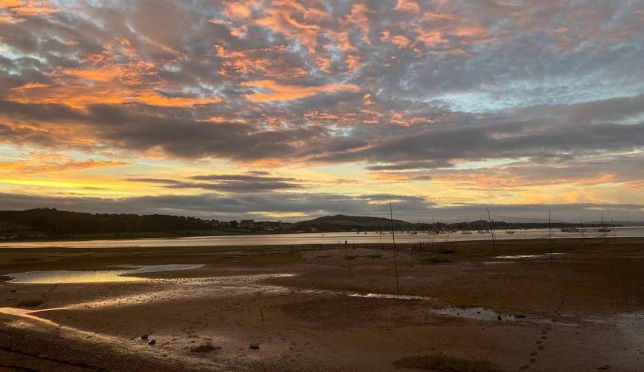 Sunset at the Island, showing both lines of mist-nets © David Scott
Two lines of full height nets were set shortly after sunset, 1 heading from the hide towards the point and the second at 90’ heading towards the railway. The team retreated to wait for dark and to allow Oystercatchers already in the area to settle down. Under our CV-19 risk assessment, we cannot use the hide at Dawlish due to issues with social distancing and the increased risk of working in enclosed spaces, so the team enjoyed a meal of fish and chips kindly delivered by Nik Ward in the dunes behind the hide (Thanks to Nik!). Shortly after dark, the tape lures were deployed. This time at a slightly quieter level and using a breeding season call which Ryan Burrell had received from another wader researcher.
After a few blank rounds, as the tide approached, a single juvenile Dunlin was caught and promptly colour-ringed and released. This is the 8th Dunlin now colour-ringed in the estuary as part of our colour-ringing project. As the tide drew closer, the numbers of Oystercatchers, Redshank and Dunlin rose across the Warren, with estimates using the thermal scope of approximately 300 Oystercatchers spread between the Island, Recharge Area and Finger Point. As high tide approached, we were lucky to catch small groups of Oystercatchers and Redshank as they moved between roost locations. Finally, a further two Oystercatchers were caught shortly before the nets were taken down at 2230. After the kit was taken in, all birds were ringed, colour-ringed where appropriate and released. The two juvenile Oystercatchers were GPS-tagged by Lizzie Grayshon and Ryan Burrell before being released.
Fantastically, after only a few days committed DCWRG colour-ring resighter, Lee Collins has already seen many of the newly marked Oystercatchers and the Dunlin back at the Warren. Hopefully, the first movements of our tagged juveniles have already been downloaded to the base station at Finger Point.
The DCWRG committee wishes to extend a special thanks to the Steve, Stephen and Phil of Teignbridge Council for allowing us to access the site and for providing sanitised waders to team members who needed them. Thanks also go to Devon Wildlife Trust and the Warren Golf Club for allowing our continued access to the site under the current situation.
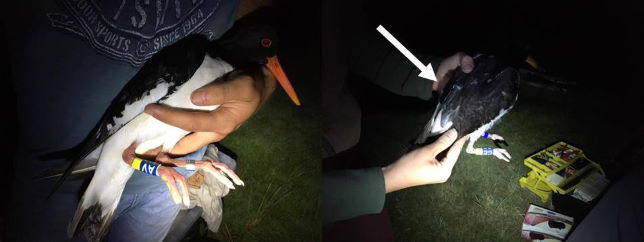 Adult Oystercatcher AV (age - 8) newly colour-ringed (left) and a newly tagged (white-arrow) juvenile Oystercatcher CE.